Starting a New Business? Then let’s talk about those early steps on the entrepreneurial Ladder!
The entrepreneurial spirit is alive and well and seems to thrive irrespective of political and economic climate especially here in the UK.
There are over 400,000 business births a year in the UK in a population of just over sixty five million and a working population of around thirty two million. That is an astonishing rate of one in every 80 working adults setting up their own business each year.
The picture for business start ups and closures around the country can be quite varied. For example in 2016 in Birmingham there were four business closures for every seven business start ups whilst in Brighton there was nearly one closure for every two business start-ups.
In Birmingham the five year survival rate was only 36% whilst Cambridge enjoyed the highest survival rate of 49% after five years.
The ONS recently published data for births and deaths for all businesses including sole traders, Ltd. companies and both Vat and Non VAT registered.
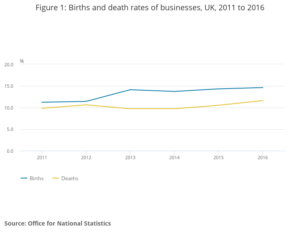
For VAT registered businesses, around 9.7% nationally will cease trading each year. So there are obvious challenges to the entrepreneur looking not only to establish a business but one that thrives.
So it is both a puzzle and a concern just how many first-time entrepreneurs seem to jump into business without due consideration around what to expect along the way and without sufficient planning and modelling.
This despite the figures for businesses ceasing trading to be alarmingly high.
The first stage on the ladder is clearly start-up. This is usually characterised financially by either an investment or loan, or the bootstraps approach. Either requires a clear sense of what is achievable, with goals and milestones set out clearly. i.e. A Plan. Given the heavy time and energy commitment at this stage, clear planning will also take into account the time budget for both finding the business and delivering the business.
Survival is the first objective for any business. Michael E Gerber wrote in the E-Myth about just how important it is to get the balance between technician, manager and entrepreneur right in our businesses. This is particularly important if at first we are the only or main employee. Often entrepreneurs will start their business armed with massive amounts of energy, confidence and determination. And these are essential qualities in the very early stages. Beyond this however, it is vital to have mapped the possible financial future and structure of the business, or, even better still across a range of outcomes.
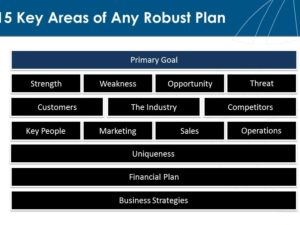
We are not talking here simply of a financial plan to support any initial lending to the business, although that is of course an essential early step. What we mean here is realistic plan for financial growth, with key activities such as marketing investment and staff recruitment factored into the future growth plans, and the strategies that will be adopted to realise them.
We also have to budget and organise for our time, and energy. Entrepreneurs will typically be self-sacrificial particularly in the early months and years, but would not have gone into business with the intention of that being a long term situation. We usually go into business to thrive, and have the life experiences and family experiences that give us meaning and purpose. As the pre-flight briefing always makes clear: we must ensure we put on our own oxygen masks first.
Our next rung then is that of the established business. At this point cashflow is more predictable, marketing and sales strategies are being tested, measured and adapted and there is a reasonable grasp of the key financials. We will be making profit or shortly getting there – it is in the trajectory.
If we started with the financial bootstrap option, then by now we should be backing our business and looking for an external investment or to borrow to grow.
At this stage, our start-up qualities of resilience and determination will be evolving, and we will be looking to organise around systems and team. At this point, we are looking beyond our internal resources to start to build a business that could ultimately work without us.

So do we have reason to be optimistic? It is great to see that the entrepreneurial spirit is alive and well. It is disappointing equally to see how unprepared and unnecessarily risk-taking many business owners can be. In my opinion, many factors contribute to the success or otherwise of the business, some of which lie beyond our control. However, a positive (healthy) mindset and our practical approach are both individual and symbiotic factors in success.
What Gerber and others have taught us is that the investment in self, the investment in learning and the structured approach through systems will mitigate against the risk and give us every chance of success.
So, here is to your success!
Gavin Bellamy
Business Growth and Planning Specialist.