
Five Ways UK SMEs Can Turn Mark Carney's Davos Speech Into Strategic Opportunity
When Canadian Prime Minister Mark Carney stood before global leaders at Davos last month, his message was unequivocal: we’re witnessing a rupture in the global order, not merely a transition. For UK SMEs watching the geopolitical landscape shift beneath their feet, Carney’s speech wasn’t just political commentary—it was a strategic roadmap for businesses willing to act decisively.
Carney spoke of “living within a lie”—the fiction that the old rules-based international order still functions as advertised. For owner-managed businesses across the UK this rupture presents five concrete opportunities to strengthen operations and build genuine competitive advantage.
1. Diversify Your Market Exposure Before You’re Forced To
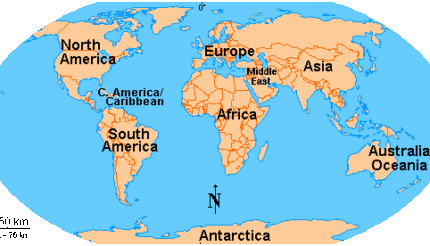
Carney’s core message centred on reducing vulnerability through strategic diversification. Recent data shows UK SMEs are already responding: business travel intentions to Asia have surged 26% year-on-year, with Africa up 16% and the Middle East gaining significant traction. These aren’t vanity metrics—they represent businesses actively reducing their dependence on traditional markets that increasingly carry concentration risk.
The opportunity isn’t simply geographic expansion—it’s strategic resilience. When one major market faces disruption, your revenue streams remain protected. The businesses winning in 2026 aren’t those with the largest markets; they’re those with the most diversified ones.
2. Build Strategic Autonomy Through Operational Control
Carney emphasised that countries—and by extension, businesses—must develop “greater strategic autonomy” in critical areas. For SMEs, this translates directly into examining your supply chains, key dependencies, and operational bottlenecks.
Which single supplier could paralyse your operations if they suddenly increased prices by 30%? Which currency exposure could devastate your margins? Strategic autonomy means identifying these vulnerabilities now and systematically reducing them. It’s not paranoia—it’s prudent risk management in an era where economic integration is increasingly weaponised.
3. Form Your Own “Variable Geometry” Partnerships
One of Carney’s most actionable concepts was “variable geometry”—building different coalitions for different purposes based on shared interests. UK SMEs can apply this thinking immediately by moving beyond traditional, single-vendor relationships toward flexible partnership networks.
Rather than relying on one logistics provider, one payment processor, or one marketing agency, successful businesses are building ecosystems of partners they can activate based on specific needs. This approach delivers both resilience and cost efficiency—you’re not locked into rigid contracts when market conditions shift.
4. Capitalise on the Flight to Stability and Values
Carney positioned Canada as “a stable, reliable partner in a world that is anything but.” UK SMEs can adopt this same positioning in their markets. In times of disruption, clients and partners increasingly value reliability, transparency, and shared values over purely transactional relationships.
This isn’t about virtue signalling—it’s about recognising that 87% of European SMEs are maintaining or expanding Asia-Pacific exports precisely because they’re seeking stable, predictable partners. If your business offers genuine reliability and clear values, this moment rewards you. Make it explicit in your positioning and operations.
5. Invest in Digital Infrastructure That Enables Global Reach
Carney spoke of Canada’s trillion-dollar investment in infrastructure, AI, and critical capabilities. For SMEs, the equivalent is robust digital infrastructure that allows you to operate seamlessly across borders. Modern fintech solutions now enable instant cross-border payments, natural currency hedging, and rapid market entry—capabilities once reserved for multinationals.
Yet research shows half of internationally-trading UK SMEs lack proactive foreign exchange strategies, and many are still operating with single-currency accounts. The SMEs gaining ground in 2026 are those treating their payment infrastructure, digital presence, and technology stack as strategic assets, not administrative necessities.
The Underlying Principle
Carney’s speech concluded with a call to “stop living within the lie”—to acknowledge reality and act accordingly. For UK SMEs, this means moving beyond comfortable assumptions that served us in stable times. The old order isn’t returning. Nostalgia, as Carney noted, is not a strategy.
The businesses that thrive through this rupture won’t be those with the most resources—they’ll be those that recognise the moment and respond with clarity and purpose. The opportunity exists precisely because many businesses are still waiting for stability to return rather than building it themselves.
The question isn’t whether the landscape is changing—it’s whether you’re using that change as the catalyst to build a stronger, more resilient business. That starts with honest assessment and decisive action.
Ready to strengthen your business against an uncertain landscape? Let’s discuss how strategic coaching can help you turn disruption into competitive advantage. Just e-mail me at rogerpemberton@actioncoach.com to explore further.